


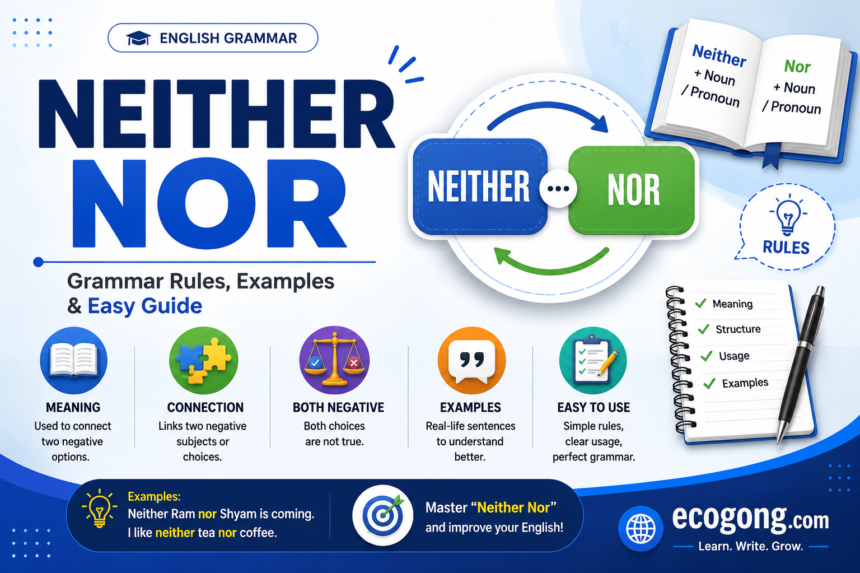
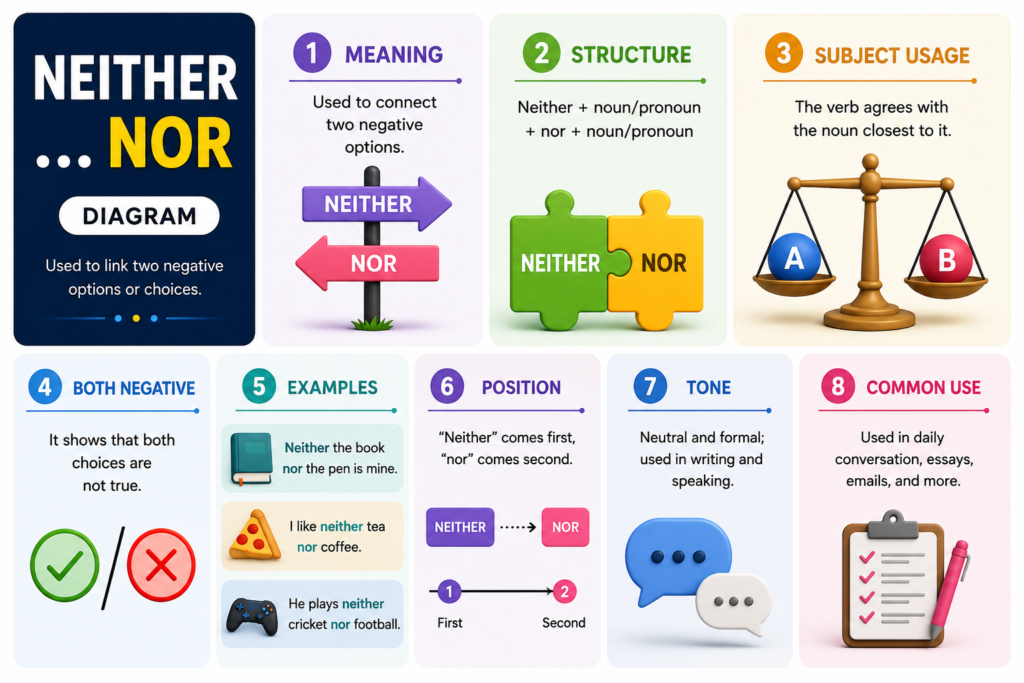
The use of “Neither nor” connects two negative thoughts. It translates to “not just this one, but also that one is excluded.” For example: “Neither the coffee nor the tea was fresh.” The verb is referred to the noun closest to it, here “is” goes together with “tea,” not with the whole subject.
Neither Nor: Meaning, Grammar Rules & Examples
You are writing an email when you suddenly realize that the phrase “Neither the client nor the vendor is/are satisfied with the schedule” leaves you confused about which verb to use.
If you ever found yourself wondering what the meaning of neither nor is, you are not the only one. While the concept itself is straight forward, the rules of using this phrase are rarely explained correctly.
The guide below will show you what “neither nor” means and the rules of using it and how important the rule of the verb agreement is. You will also learn about the punctuation rules that are often misunderstood by many writers. The meanings of two frequently used idioms; “neither here nor there” and “neither a borrower nor a lender be” with their meanings will also be discussed.
What Does “Neither Nor” Mean?
Neither nor meaning, in little: it lets you say “no” to two idea at once.
Also, having to use two separate negative expressions, “neither nor” put it all together into a single statement.
- ❌ “I don’t like tea. I don’t like coffee.”
- ✅ “I like neither tea nor coffee.”
The expression can be used for people, objects, actions, and characteristics.
Examples:
- “Neither the manager nor the intern arrived.”
- “The plan was lacking on the research and funding fronts – neither was taken care of.”
- “She has not called nor texted.”
Not Forgot this: “neither” and “nor” are go same together. You also use one without the other. Think of them as the negative twin of “both and.”
Neither Nor vs. Either Or
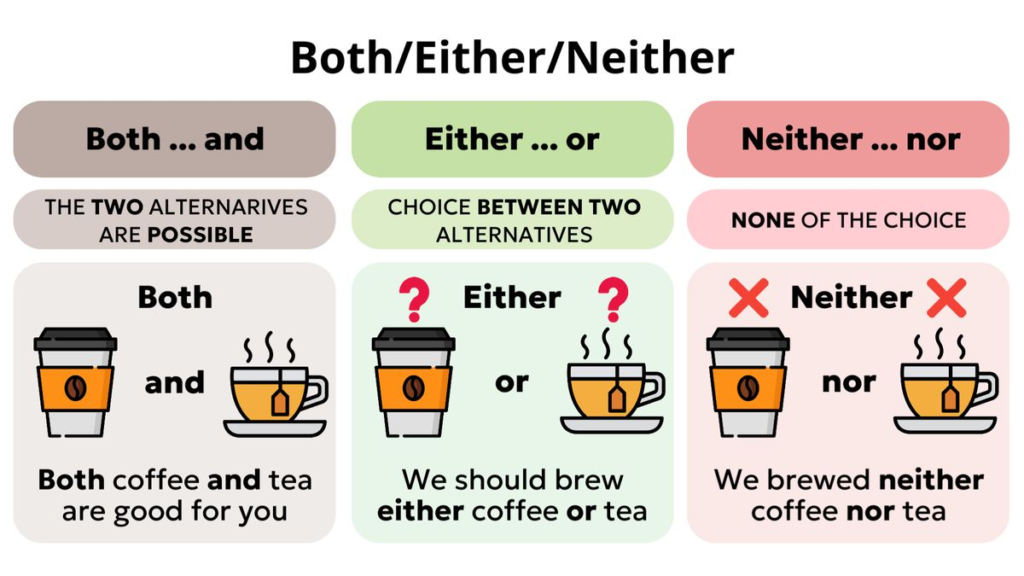
The question: is it “neither nor or neither or”? The two are not interchangeable. Here we explain how to differentiate between them.
- “Either or” offers a positive: “You can have either tea or coffee.”
- “Neither nor” rejects both : “I want neither tea nor coffee.”
The confusion usually arises when the two are combined.
Example: ‘I don’t want tea or coffee.’ A better lexical choice would be: ‘I want neither tea nor coffee.’
Both of these sentences are grammatically correct, but ‘neither nor’ has more of an advantage in that it’s phrased more easy to understand.
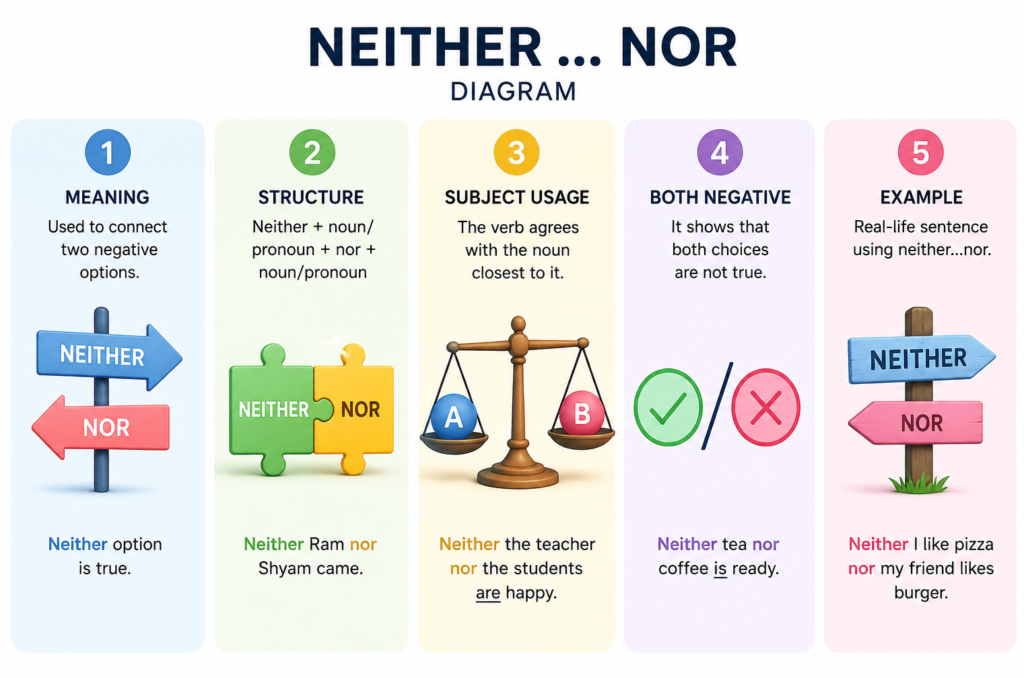
The Subject-Verb Agreement Rule
This one rule is responsible for many mistakes throughout this guide. Indeed, grammar books rarely explain it properly, so let’s go ahead and deal with it.
When matching a verb with a subject, one should not treat the entire subject.
Linguists call this principle “the principle of proximity.”
| Sentence | Why It’s Correct |
|---|---|
| Neither the teacher nor the students were ready. | “Students” sits closest to the verb. |
| Neither the students nor the teacher was ready. | “Teacher” (singular) sits closest to the verb. |
| Neither he nor I am responsible. | “I” sits closest, so the verb matches “I.” |
| Neither the cat nor the dogs are allowed inside. | “Dogs” (plural) sits closest to the verb. |
here you can show shortcut that works every time: cover the first half of the word and read only what comes after “nor.”
one example: “Neither the teacher nor the students ready.” Cover “Neither the teacher nor,” and are you left with “the students were ready.” That gives you your answer were.
Punctuation Rules for Neither Nor
The punctuation rules concerning the usage of commas in this regard are simpler than other manuals may say; however, there are two situations where special attention is required.
Firstly, no comma is needed in short lists with two elements.
- Correct: “She neither called nor emailed.”
- No comma is required before ‘nor’ in one clause.
The second situation is when “neither nor” connects two independent clauses, which means both parts can be complete sentences.
- Correct: “Neither did the flight arrive on time nor did the airline give its explanation.”
- Both parts can stand on their own, and adding a comma only helps with the understanding.
The last thing is that if there are three items or more, they have to be interpreted as a normal list.
- Correct: “The hotel had neither air conditioner, hot water, nor working elevator.”
Can You Use “Nor” Without “Neither”?
Yes. The standalone version of “nor” is used in two different situations.
First, it is used to state another negative point after a sentence has been expressed in the negative form.
- “I do not smoke nor do I drink.”
- You should note the inversion created by the use of “nor;” it is “do I smoke” and not “I do smoke.” This is important in formal writing.
Secondly, standalone “nor” can be used in formal and literary writing to show that a negative thought continues in the subsequent sentence.
- “He never apologized. Nor did he provide an explanation.”
A good rule of thumb is that if the previous sentence has a negative word such as “not,” “never,” or “no,” it can be followed by a second sentence with the word “nor” instead of using “neither.”
“Neither Here Nor There” — Meaning and Origin
This expression conveys a meaning of being irrelevant or unrelated to the issue being discussed. It is not connected with the location itself.
For example, “I realize you are familiar with this software, but that doesn’t matter; everyone still has to complete the training.”
The term dates back to at least the 16th century and has been used in one form or another by English speakers ever since. The logic behind the expression is clear: when something is referred to as being “neither here nor there,” it doesn’t belong to both sides of a comparison. You need to keep in mind the fact that.
- When you wish to politely nip a distraction in the bud during a meeting or conversation
Whenever you want to bring attention back to important matters
When you want to acknowledge someone’s argument without letting it steer the conversation in a different direction
It is advisable not to use this expression in a very formal setting like an academic paper or a formal document. It might sound rude in such cases.
“Neither a Borrower Nor a Lender Be” Meaning and Origin
The phrase originates from William Shakespeare’s play, Hamlet, where Polonius gives his son Laertes this piece of advice right before he heads off to Paris.
The message of this quote is simple: don’t lend or borrow any money from your friends or family, as money is known to ruin relationships and distract you from duties.
The full quote contains the idea, “never be a borrower or lender”, since loans tend to ruin both a lender and a borrower, while borrowing can dull the sense of thriftiness.
Now, present time, many people like to use this phrase, either jokingly or in a serious manner, whenever someone needs to lend money or when relationships and money are discussed in public.
For example, “My uncle has always taught me that one shouldn’t be a borrower or lender, as he never shares a bill with anyone.”
However, it should be mentioned that this quote is a proverb and not a dogma, for there are many good examples of realization of borrowing and lending in financially sustainable relationships.
American vs. British English Differences
The main grammar are comes to same in US, UK, and Indian English. check below some best differences are worth noting.
- In British English “neither” is pronounced as /ˈnaɪðə/ (“ny-ther”), while American English pronounces it as /ˈniːðər/ (“nee-ther”). Both pronunciations are valid in both dialects; it’s a matter of choice and not of regulation.
- British formal writing, in particular that of journalism and academia, depends heavily on the proximity rule of verb agreement; American usage sometimes defaults to the plural form in informal contexts no matter what. Nevertheless, the rule holds with formal writing.
- Indian English is a hybrid between British tradition and local adaptability and maintains the degree of formality of that British system in vertical writing.
Comparison Table: Neither/Nor vs Either/Or
| Point | Neither Nor | Either Or |
|---|---|---|
| Meaning | Negative (not this, not that) | Positive/choice (this or that) |
| Example | Neither red nor blue looks right. | Either red or blue will work. |
| Verb agreement | Matches the noun closest to the verb | Matches the noun closest to the verb |
| Common error | Defaulting to a plural verb | Defaulting to a singular verb |
| Formality | Works in both formal and casual writing | Works in both formal and casual writing |
| Standalone use | “Nor” can stand alone after a negative | “Or” can stand alone in lists |
Pros and Cons of Using Neither Nor in Writing
Advantages:
- This method brings two negative expressions together.
- It results in a more elegant expression than using “not.”
- It works well for formal writing and spoken language.
Disadvantages:
- There is a danger of making a mistake when pairing singular and plural nouns with the wrong verb.
- It may seem overly formal in casual conversation.
- Also, It requires additional attention to punctuation when connecting complete independent clauses.
Common Mistakes to Avoid
1#. The subject-verb agreement is incorrect
- Wrong: Now, Neither the coach nor the players were pleased with the news.
- Correct: Neither the coach nor the players was pleased with the news since “coach” is singular.
2#. Using the word “or” with “neither.”
- Wrong: I don’t like neither coffee or tea.
- Correct: I don’t like neither coffee nor tea. In fact, as a matter of principle the word “neither” always comes with “nor,” but never with “or.”
3#. Forgetting the inversion of subject and verb
- Wrong: I don’t drink tea, nor I drink coffee.
- Correct: I don’t drink tea, nor do I drink coffee.
4#. Trying to use “neither nor” for more than two items.
- Not good: Neither pizza, pasta or salad was good.
- Good: None of the pizza, pasta or salad was good.
- According to strict grammar neither nor can be used for more than two items, but in most cases none of is a more natural phrase.
5#. Mistaking for a double negative
- Wrong: I don’t like neither coffee nor tea.
- Correct: I like neither coffee nor tea.
Expert Tips for Getting It Right Every Time
You may try the so called “cover the first half” technique regarding ensuring that verb agreement is correct. This technique is faster than mastering the grammar rule, and it brings correct results in the majority of cases.
When you read the sentence out loud, your ear catches the mistakes in agreement quite well. Trust your instincts as this is one of the first checks.
Try to use “neither nor” only when you deal with only two items. In this case, you may prefer to use “none of” for three and more items.
Always check the agreement in a formal writing context. Emails, reports, and resumes are the places where employers and editors catch this mistake easily.
Don’t use this pattern too often when speaking. In spoken language “I want tea or coffee” is more natural than “I want neither tea nor coffee.”
FAQs
1. What does “neither nor” mean in a sentence? It rejects two things both “not this, and not that” combined into one phrase.
2. Is it “neither nor” or “neither or”? Always “neither nor.” “Neither” never pairs with “or” also that combination to “either or.”
3. Can “neither” take a singular verb? Yes, when it stands alone as a subject: “Neither of us is ready.” Here, “neither” like as a singular subject.
4. Is “neither nor” formal or informal? It works in both like good, also it shows up more often in formal or written English.
5. What does “neither here nor there” mean? It means like is irrelevant or beside the point unrelated to the current idea or decision.
6. Where does “neither a borrower nor a lender be” come from? It’s a line from Shakespeare’s Hamlet, spoken by Polonius, also warn to lending or borrowing money to protect relationships.
7. Can you start a sentence with “nor”? Yes, especially in formal writing, when you’re come a negative idea from the sentence before: “He didn’t apologize. Nor did he explain himself.”
8. Does “neither nor” always need a comma? No. Add one only when joining two full independent clauses or listing three or more items. Simple two-item pairings skip the comma.
9. Is “neither nor” grammatically correct with three items? yes, but it can sound clunky. Many writers prefer “none of” for three or more items.
10. What’s the difference between “neither nor” and “not or”? Both same. “Neither nor” sounds more best, while “not or” fits casual speech fine.
Final Words
The concept of neither nor may not necessarily seem as complex as it is. Once someone has learned two things to match the verb to the noun closest to it, and to remember that neither goes with nor, not with or all other related aspects will fall in place automatically.
Here is the one thing this guide expects its readers to do, which is to take advantage of the veoma effective “covering the first part” technique with respect to verb agreement, which will eliminate most mistakes instantly, without you having to refer to formal grammar rules.
And the next time someone refers to something as being neither here nor there or makes a joke about being neither a lender nor a borrower you will understand the origin and meaning of those phrases perfectly.