


Quick Answer
A conjunction is a joining word. also connects two words, two ideas and two sentences together. “And,” “but,” “or,” and “because” are all conjunctions. Without them, writing sounds choppy, like a list. There are three types: coordinating, subordinating and correlative. Once you know these three, the rest is easy.
What Is a Conjunction? The Simple Conjunction Definition
Now check below this simple.
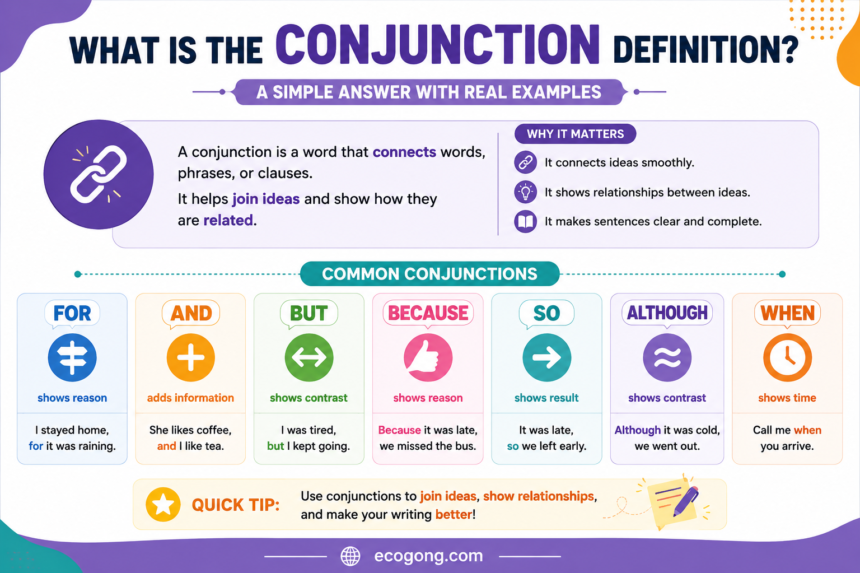
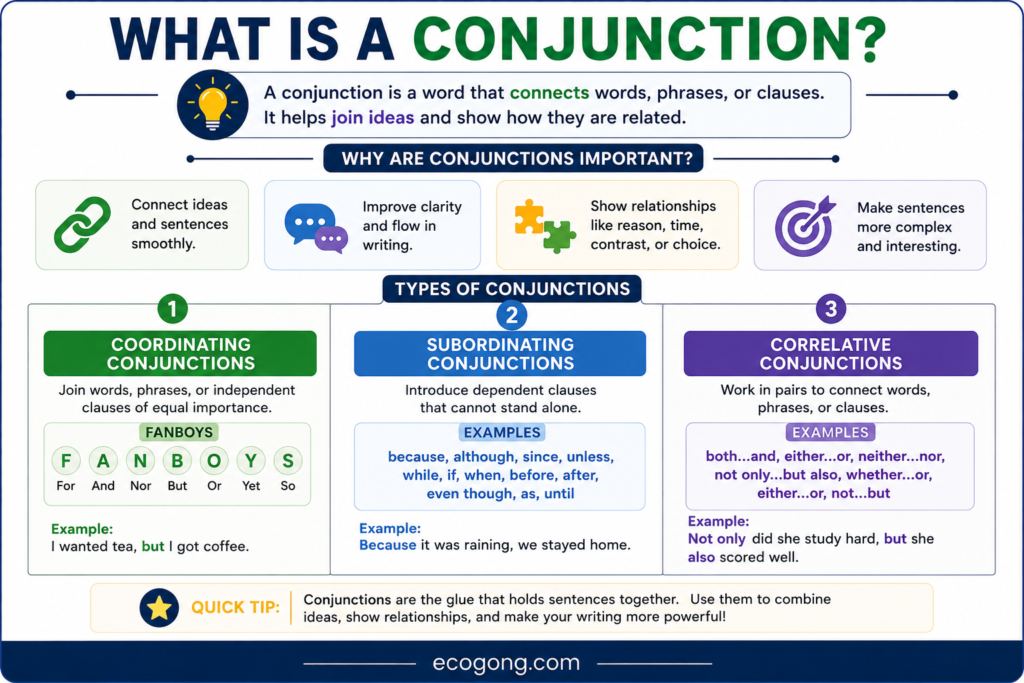
Conjunction definition: A conjunction is a word that joins two things like two words, two ideas, or two sentences.
That is really all it is. No need to make it harder than that.
Imagine a rope. By itself, it does not do much. But tie it to something, and now you have something that binds two things together. A conjunction is much the same way.
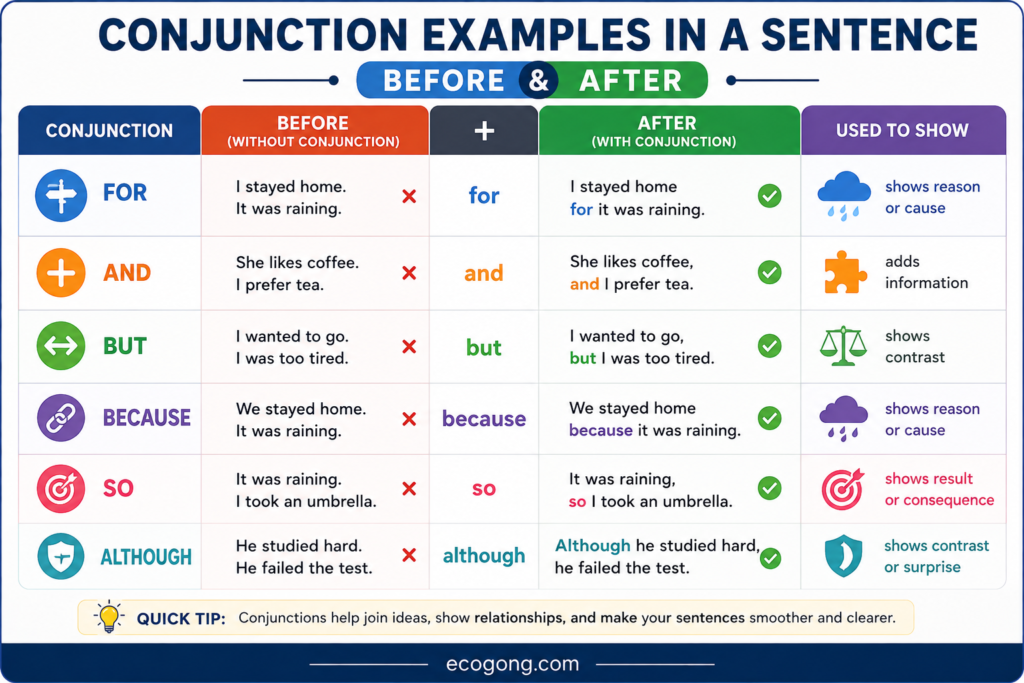
Without a conjunction: “I was tired. I kept working.”
With a conjunction: “I was tired, but I kept working.”
Can you sense the difference? The second one almost seems to flow. In addition, this second one tells you more. Also, gives you a little more insight into what happened. It shows that the writer was tired, but still manages to keep going. It all comes from one word.
So if you are been searching “what is a conjunction” and wanted a real answer, not a textbook one there it is. A joining word. Nothing scary about it. check below guide.
The Easiest Way to Remember It
If you remember only one thing from these tips, let it be this: a conjunction is simply a word that connects.
That is the brief, most important definition. You may know more about conjunctions than you think. You don’t need to be a grammar expert to use conjunctions. Just remember that they are words used to connect ideas.
Why This Tiny Word Does So Much Work
Here is this something funny. Most of us learned how to use conjunctions in third or fourth grade. We probably haven’t even thought about them since.
But go back and read something you wrote in a hurry a text, an email, a quick note. Chances are, if it feels choppy or off, a missing or weak conjunction is often the reason.
I know that when I’m reading through peoples emails or other writing that they have done quickly, it’s rarely a huge grammatical error. It’s more often run on sentences or choppy ones with nothing between them.
Trust me, you’ll see what I mean if you try reading this out loud:
“We launched the product, sales were slow, we changed the price, sales went up.”
vs.
“We launched the product, but sales were slow, once we changed the price, sales went up.”
Doesn’t the second one sound more like something a real human being might say? The first one is robot-like and non-personal, almost as if it was generated by some artificial intelligence.
The same thing applies to:
- Emails: connected sentences sound more confident.
- Resumes: “Managed a team and grew sales by 20%” hits harder than two separate half thoughts.
- School papers: smoother writing usually means a better grade also even if the ideas are the same.
- Texting your friends: even casual writing feels more natural with the right connector word.
So no, my friend, learning about conjunctions is actually very important, because even if you are not aware of it, they are making all sorts of different parts of your writing and speaking sound better than they would otherwise be.
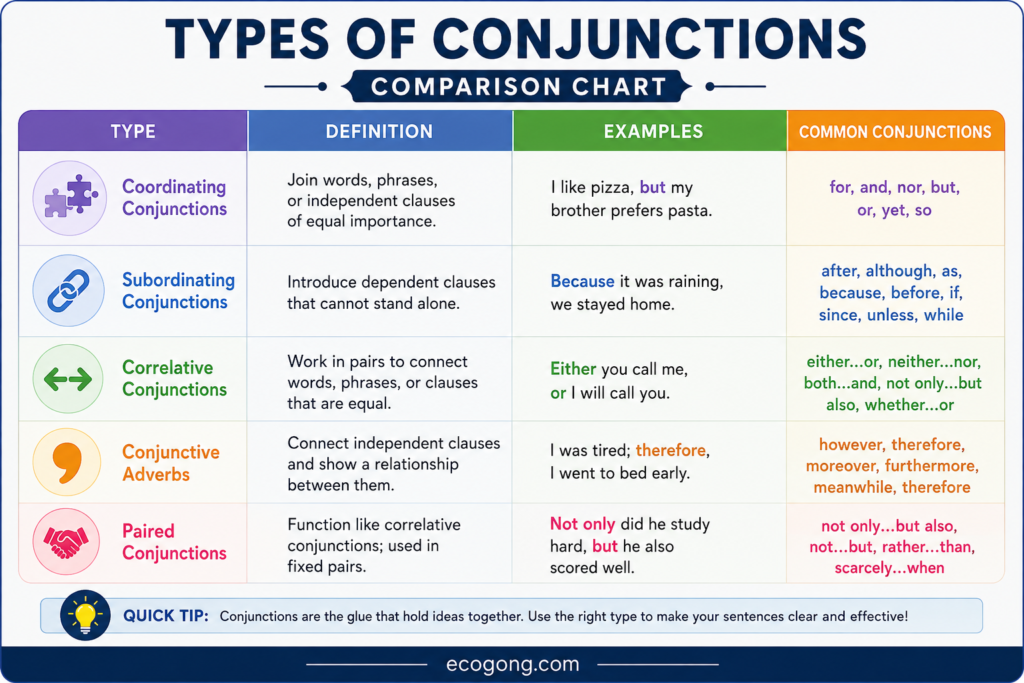
The 3 Types of Conjunctions (Explained Like a Friend Would)
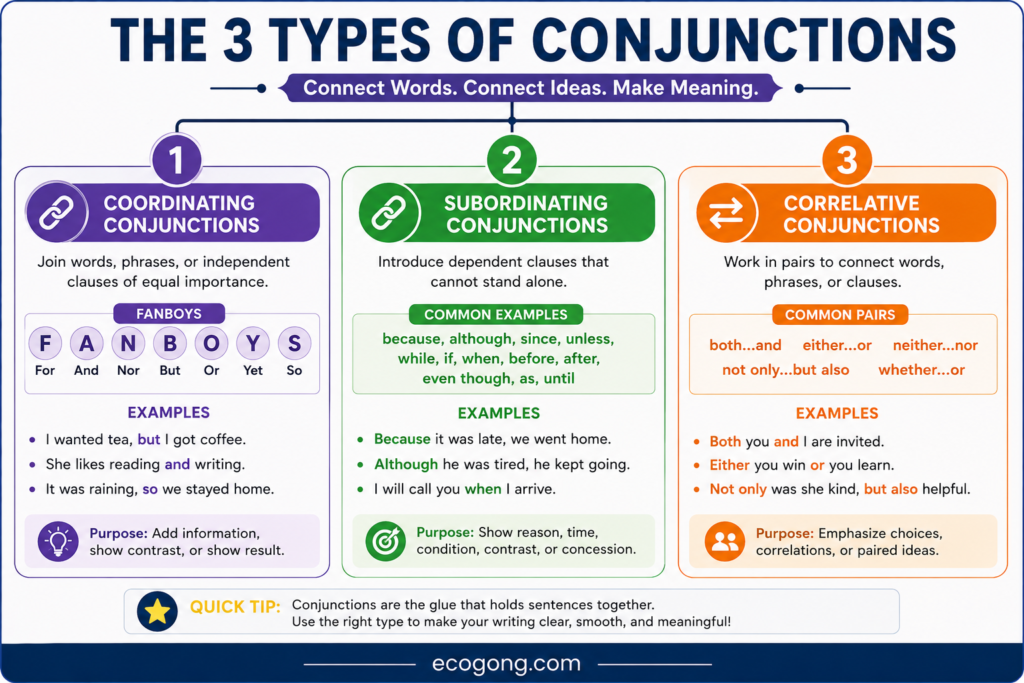
There are three kinds. Each one has its own job. check below go one by one.
Type 1: Coordinating Conjunctions
These join two equal ideas, same size, same weight.
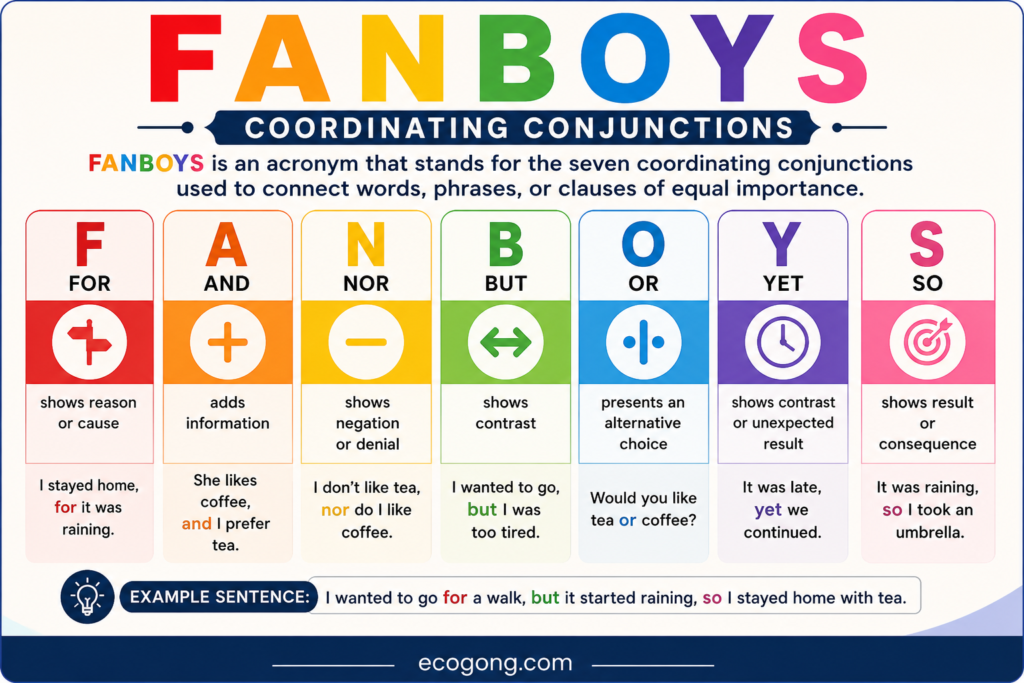
There are only seven of them. Most people remember them using the word FANBOYS:
| Letter | Word |
|---|---|
| F | for |
| A | and |
| N | nor |
| B | but |
| O | or |
| Y | yet |
| S | so |
Example: “I wanted pizza, but we had sushi instead.”
Now this Both of that sentence could stand alone. The comma and “but” just tie them together.
Type 2: Subordinating Conjunctions
These words joins the main idea to the one depending on it.
Most common of these are because, although, since, unless, while, if, before, after, until.
For example: I left early because I had a headache.
Try saying “because I had a headache”
in isolation. It does not sound like a complete thought, which is why we need the first part of the sentence.
Type 3: Correlative Conjunctions
These are used in pair to make them work properly, just like how a pair of socks works.
Common correlative conjunctions are either/or, neither/nor, both/and, not only/but also, and whether/or.
For example, “She is not only the manager but also the founder.”
The key to using correlative conjunctions is to make sure that the grammatical construction that comes after the first word is the same as the grammatical construction that comes after the second word.
Quick Comparison Table
| Type | What It Connects | Example Words | Sample Sentence |
|---|---|---|---|
| Coordinating | Two equal ideas | and, but, or, so | “She called, but no one answered.” |
| Subordinating | Main idea + smaller idea | because, although, if | “We stayed in because it rained.” |
| Correlative | Two matched ideas | either/or, both/and | “Both the client and the vendor agreed.” |
Conjunction Examples You’ll Actually Use
Most grammar sites show you sentence fragments like “The dog ran and the cat slept,” which is great for a worksheet, but not everyday language.
Here is some examples of the conjunctions in actual use.
A work email:
- “I’ve seen the draft and I have a few comments.”
- “We can delay the meeting or we can keep it at the same time.”
- “Please let me know your availability as we’re running low on time.”
In a resume:
- “Led a team of six and finished two weeks early.”
- “Not only met but exceeded quarterly goals.”
A text:
- “Running late but almost there.”
- “Can you grab milk unless you already left?”
In casual conversation:
- “I would love to come but I’m very tired.”
- “We either fix it or we deal with the consequences.”_
Say these quotes out loud and you can hear the difference. You want the conjunctions to be natural and seamless as if the person was not even thinking about it.
“In Conjunction With” — What Does That Even Mean?
This one is tricky because it can be easily confused with the grammatical definition. Let’s look at the meaning and examples to highlight the difference.
In conjunction definition (as a phrase): working together with someone or something, typically for a particular purpose.
Example: “The city is hosting the festival in conjunction with local schools,”
This means that the city and the schools are collaborating; they are not doing it alone.
You will most likely come across the term “in conjunction with” in:
- News releases: “The launch happens in conjunction with a national ad campaign,”
- legal documents: “This agreement should be read in conjunction with the attached terms,”
- Medical reports: “This medication is often used in conjunction with physical therapy,”
- Announcements of events: “The workshop is taking place in conjunction with the annual conference.”
Here come with simple trick: swap the phrase for “together with” and see if the sentence still makes sense.
“The report came out in conjunction with the audit.” → “The report came out together with the audit.” yes Still works.
And, If the swap breaks the sentence, you probably want a different word.
Conjunction vs. Preposition vs. Conjunctive Adverb
This mix is super common and honestly, most articles rush past it. check below slow down.
| Word Type | Job | Example Word | Example Sentence |
|---|---|---|---|
| Conjunction | Joins ideas or clauses | and, but, because | “I stayed home because it rained.” |
| Preposition | Shows how a noun relates to something | in, on, under, with | “The keys are under the mat.” |
| Conjunctive Adverb | Connects ideas but needs a semicolon or period | however, therefore, meanwhile | “I was tired; however, I finished the task.” |
The word people mix up the most is “however.” It feels like a conjunction because it links ideas. But you not just drop a comma before it and join two full sentences.
Wrong: “I was tired, however, I finished the task.” Right: “I was tired; however, I finished the task.”
Small fix. But it is one of this things that makes writing look either polished or a little off.
3 Myths About Conjunctions People Still Believe
Let’s get some grammar misconceptions out in the open.
Myth 1: “You cannot start a sentence with ‘and’ or ‘but.'” There is a reason that this is a myth–it’s simply not true. This rule was created to prevent children from writing sentence fragments. However, many professional writers (see: news articles, novels, and textbooks) often use this exact construction in their writing. The myth is also false because it’s good to use coordinating conjunctions in every day writing. It is not as appropriate, however, for legal writing.
Myth 2: “Using your conjunctions as much as possible makes your writing sound more educated.” This is a myth because too many conjunctions can make your writing sound uneducated. In fact, using a conjunction when a period would suffice can make your writing look sloppy. It’s best to use conjunctions when needed, and to put periods everywhere else.
Myth 3: “‘However’ is basically the same thing as ‘but.'” While these conjunctions have similar meanings, they are used in different ways. If you replace “but” with “however” in a sentence, you will end up with a comma splice–one of the most widely despised grammatical errors in modern professional writing.
Common Mistakes (And Quick Fixes)
I read through a lot of real writing also emails, essays, drafts and these mistakes show up again and again.
1: Missing conjunction (comma splice)
- ❌ “I finished the report, I sent it late.”
- ✅ “I finished the report, but I sent it late.”
2: Too many conjunctions crammed in
- ❌ “We went to the store and got milk and bread and left and it started raining.”
- ✅ “We went to the store, got milk and bread, and left just as it started raining.”
3: Mismatched pairs
- ❌ “Either you call or texting me works.”
- ✅ “Either you call me or you text me.”
4: Treating “however” like “but”
- ❌ “I was late, therefore, I missed the intro.”
- ✅ “I was late; therefore, I missed the intro.”
5: Forgetting the comma in a long sentence
- ❌ “She finished the slides but forgot to send them to the team before the meeting started.”
- ✅ “She finished the slides, but she forgot to send them to the team before the meeting started.”
A simple habit fixes most of this: read your sentence out loud. If you are out of breath, or it feels tangled, that is your sign to fix the punctuation or split it into two.
Punctuation Rules Made Simple
This part scares people more than it has to. Here’s the quick version.
Rule 1. Use a comma before FANBOYS when you have two complete sentences joined by a conjunction. I wanted to leave, but the meeting dragged on forever (notice that both parts of the sentence could be standalone sentences).
Rule 2. Don’t use a comma if the second part of the sentence isn’t a complete sentence. I wanted to leave but ended up staying anyway (notice that “ended up staying anyway” can’t be a standalone sentence).
Rule 3. If you’re using a subordinating conjunction make sure it either doesn’t come at the beginning of the sentence or that you put a comma after it (not both). Because it rained we stayed in (no comma needed since the subordinating conjunction “because” comes in the middle of the sentence). We stayed in because it rained (again, no comma needed since the subordinating conjunction “because” comes in the middle of the sentence).
Rule 4. Use a semicolon ( ; ) NOT a comma before transitional words like however and therefore. I finished early; however, I decided to stick around and help out.
Memorize these four rules and you’ll be acing your conjunction sentences in no time!.
Pros and Cons of Using Conjunctions a Lot
Conjunctions are useful, but too much of a good thing can often be a bad thing.
Pros:
- Make sentences flow smoothly
- Make sentences connect
- Show relationships between sentences (such as cause/effect or choice)
- Make emails and resume sound better
- Prevent sentences from sounding too short and choppy
Cons:
- Using too many conjunctions within one sentence can confuse readers
- Now use to many “and’s” can make sentences run on together without end
- Using the wrong conjunction can change what you are trying to say
- Using “and” or “but” at the beginning of every sentence gets old after a while
The key to using conjunctions properly is not to use them too often, or even at all; but when used, use the correct conjunction to ensure that the sentence is properly made.
Tips That Actually Help You Write Better
A few best tips that make a real difference, based on what really works:
- Read it out loud. If you are gasping for air, split the sentence.
- Starting with “and” or “but” is fine now. This rule changed. Most modern style guides accept it, especially for blogs, emails and everyday writing.
- Pick the conjunction that matches the relationship.
- Showing contrast → but, although
- Showing cause → because, since
- Showing a choice → or, either/or
- Adding on → and, both/and
- Keep correlative pairs balanced. Whatever comes after the first word should match the second.
- Mix up your sentence starters. If every sentence starts with “I,” try starting one with “because” or “after” instead.
- Do not be afraid of short sentences. Not every thought needs a conjunction. Sometimes a period says it better.
FAQs
What is a conjunction in simple words? A conjunction is a word that connects other words or sentences, like “and,” “but,” or “because.”
What are the 7 main conjunctions? The seven coordinating conjunctions are for, and, nor, but, or, yet, and so. People remember them using the word FANBOYS.
Can a sentence start with a conjunction? Yes. Starting with “and” or “but” is fine today, especially in blogs, emails, and everyday writing.
What is the difference between a conjunction and a preposition? A conjunction connects ideas or clauses, like “because” or “but.” A preposition shows how a noun relates to something else, like “in,” “on,” or “under.”
Is “however” a conjunction? Not quite. also this called a conjunctive adverb. It connects ideas, but it needs a semicolon or period before it not just a comma.
What are correlative conjunctions? They are matched word pairs, like “either/or” or “both/and,” that connect two balanced parts of a sentence.
Why do conjunctions matter in work writing? They make emails, resumes, and reports sound clearer and more confident. Writing without this not good.
Final Words
A conjunction is a linking word. This is all you need to know for now. In this article, you will find out what coordinating, subordinating and correlative conjunctions are and learn how to spot them in emails, texts, on resumes, and elsewhere.
The real skill not memorizing the conjunction definition. It’s learning which one fits the moment cause, contrast, choice, or connection.
Try this: Take something you’ve written in the past day or week – an email or a paragraph and see if you can find places where you forgot to put in conjunctions , used too many ands , or put a comma where a period was needed. This is the type of practice that will truly help you become a better writer.