



Pokemon natures comes to quietly boost one stat by 10% and lower another by 10%. There are 25 in total. Twenty of them change stats and five “neutral” natures do nothing. They are shaped every game since Ruby and Sapphire and picking the right one can turn a Pokemon that folds in one hit into one that walls an entire team.
What Are Pokemon Natures, Really?
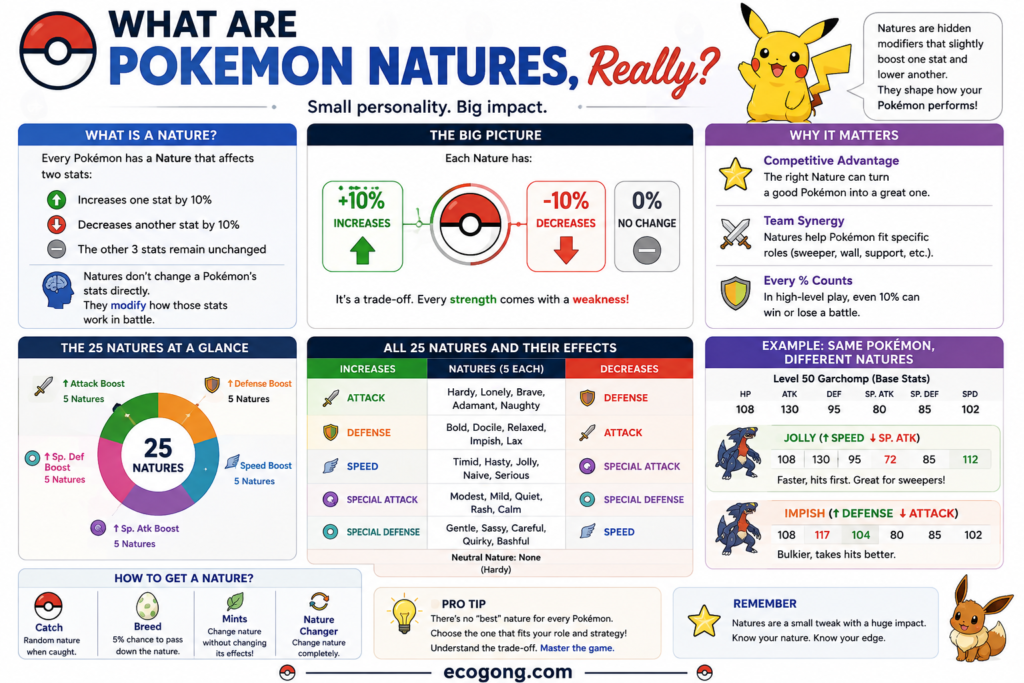
Here is check something nobody tells you upfront: every Pokemon are ever caught carries a nature, whether you noticed it or not.
A nature boosts one stat by 10% and drops another by 10%. That is the whole mechanic. It never touches HP.
So why does this matter? Two Charizard with identical IVs and EVs can perform completely differently in battle. One has a Timid nature. The other has a Brave nature. Same species, same moves, different results. That gap is the whole reason pokemon natures matter so much once you start building a serious team.
Natures first appeared in Ruby and Sapphire back in Generation 3. Since then, every mainline game has used them. If you are ever wondered why your friend Garchomp “just hits harder” than yours, nature usually explains it.
The Full Pokemon Nature Chart
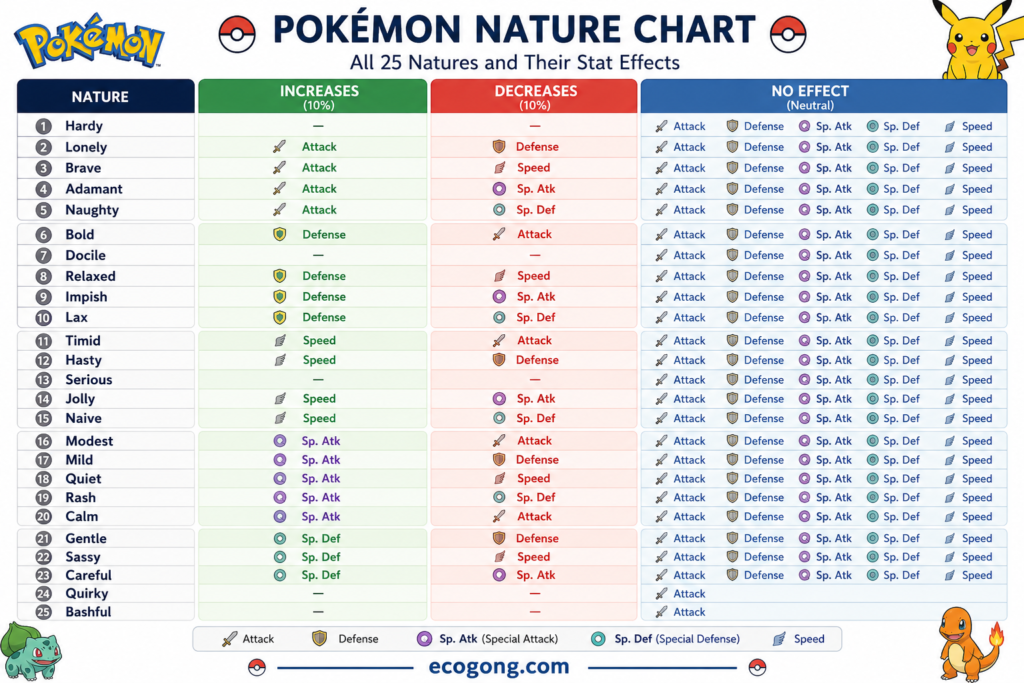
Let’s get the reference table out of the way first, since this is probably why you clicked.
| Nature | Raises | Lowers |
|---|---|---|
| Hardy | — | — |
| Lonely | Attack | Defense |
| Brave | Attack | Speed |
| Adamant | Attack | Sp. Attack |
| Naughty | Attack | Sp. Defense |
| Bold | Defense | Attack |
| Docile | — | — |
| Relaxed | Defense | Speed |
| Impish | Defense | Sp. Attack |
| Lax | Defense | Sp. Defense |
| Timid | Speed | Attack |
| Hasty | Speed | Defense |
| Serious | — | — |
| Jolly | Speed | Sp. Attack |
| Naive | Speed | Sp. Defense |
| Modest | Sp. Attack | Attack |
| Mild | Sp. Attack | Defense |
| Quiet | Sp. Attack | Speed |
| Bashful | — | — |
| Rash | Sp. Attack | Sp. Defense |
| Calm | Sp. Defense | Attack |
| Gentle | Sp. Defense | Defense |
| Sassy | Sp. Defense | Speed |
| Careful | Sp. Defense | Sp. Attack |
| Quirky | — | — |
That covers all 25 pokemon natures also Screenshot this table. You all come back to it.
An Easy Trick to Remember Which Nature Does What
Many articles and guides never teach this and honestly, it took me too long to figure out on my own.
Instead of memorizing 20 nature names, memorize the stat pairs. Only 10 pairs exist (Attack/Defense, Attack/Speed, and so on) and each pair has exactly two natures. One favors each direction.
For example, Adamant raises Attack and lowers Sp. Attack. Modest does the opposite: it raises Sp. Attack and lowers Attack. Once you spot this mirroring pattern, the chart stops feeling random.
Here is second trick. Natures that raise Speed tend to sound “fast”: Timid, Hasty, Jolly, Naive. It is not a strict rule, but it works as a quick mental hook.
Here is What a Nature Actually Does to Real Numbers
Now, many articles say “10%” and move on. Let is actually run the math.
Take a Garchomp with a base Attack stat of 130, at level 100, with solid IVs and EVs. A neutral nature lands its Attack around 328.
Now give that same Garchomp an Adamant nature, which raises Attack. That number climbs to roughly 361.
That is a real gain of about 33 points of Attack. In practice, that difference can turn a move that “almost” knocks out an opponent into one that finishes the job. This is exactly why competitive players never treat nature as an afterthought, it is free power, sitting right there for the taking.
A Real Battle Where Nature Decided the Outcome
Numbers on a stat screen are one thing. Watching them decide a real match is another.
A few seasons back, I ran a Jolly nature Landorus-Therian on a rain team. Jolly raises Speed and lowers Special Attack, which fit fine since Landorus Therian leaned physical anyway.
In one ranked match, my Landorus-Therian and the opponent Adamant nature Bisharp both sat at the same base Speed. Without the Jolly boost, Bisharp would have moved first and landed a Sucker Punch that likely knocked my Pokemon out.
Now, the Jolly nature pushed my Speed just past Bisharp. I moved first, hit with Earthquake, and took Bisharp down before it got a turn. That single 10% Speed boost decided the entire exchange.
This is the kind of moment that never shows up in a stat chart. It only shows up in an actual battle, when a speed tie becomes a speed win. If you only remember one thing from this section, remember this: nature not just change numbers on a screen. It changes who gets to move first when it counts.
Impish Nature Pokemon: The Quiet Workhorse
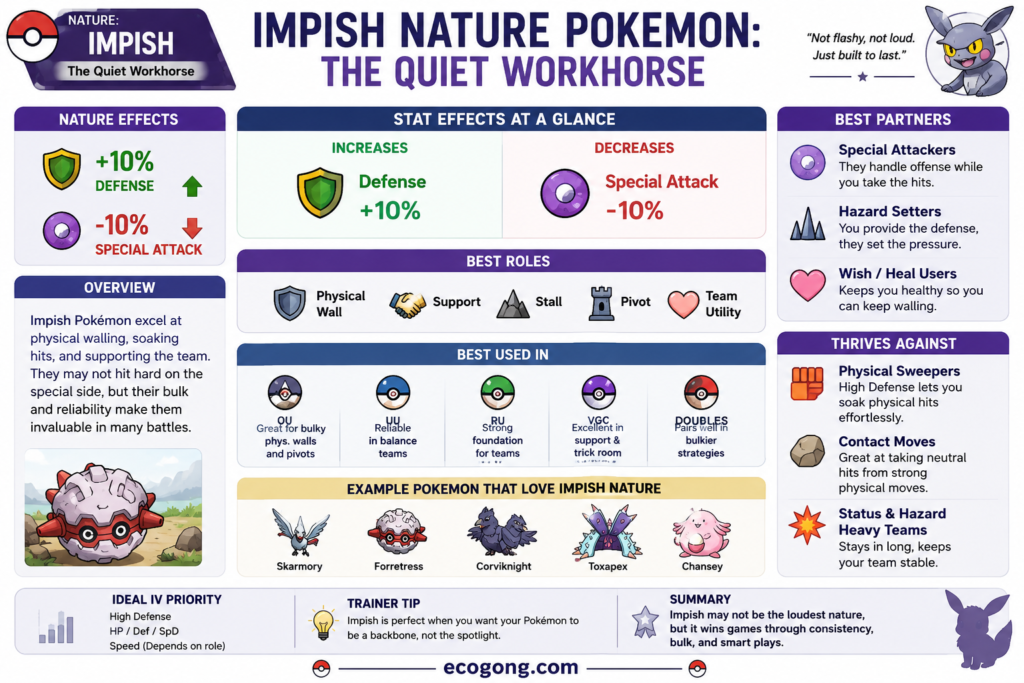
Impish raises Defense and lowers Special Attack.
This nature earns its reliability. Most defensive Pokemon never use Special Attack anyway, so the drop costs nothing. Meanwhile, the Defense boost helps them do exactly what they are built for: soak hits and punish back with physical moves.
A few real examples show this well:
- Ferrothorn: a wall that skips Special Attack entirely
- Skarmory: pure physical bulk backed by Steel-typing
- Toxapex: stalls opponents while poison chips away
- Landorus-Therian: bulky enough to tank hits, physical enough to punish
If you are setting up your first defensive Pokemon and you are unsure which nature to pick, Impish works as a safe default. Just make sure the Pokemon move set stays physical.
I am run Impish Ferrothorn on nearly every rain team I’ve built over the years, and it holds up the same way every time. It tanks Water and Electric type hits that would otherwise threaten a rain sweeper, then answers back with Gyro Ball or Power Whip. The Special Attack drop never once cost me anything, because Ferrothorn whole kit stays physical or status based anyway.
Mild Nature Pokemon: The Underrated Gamble
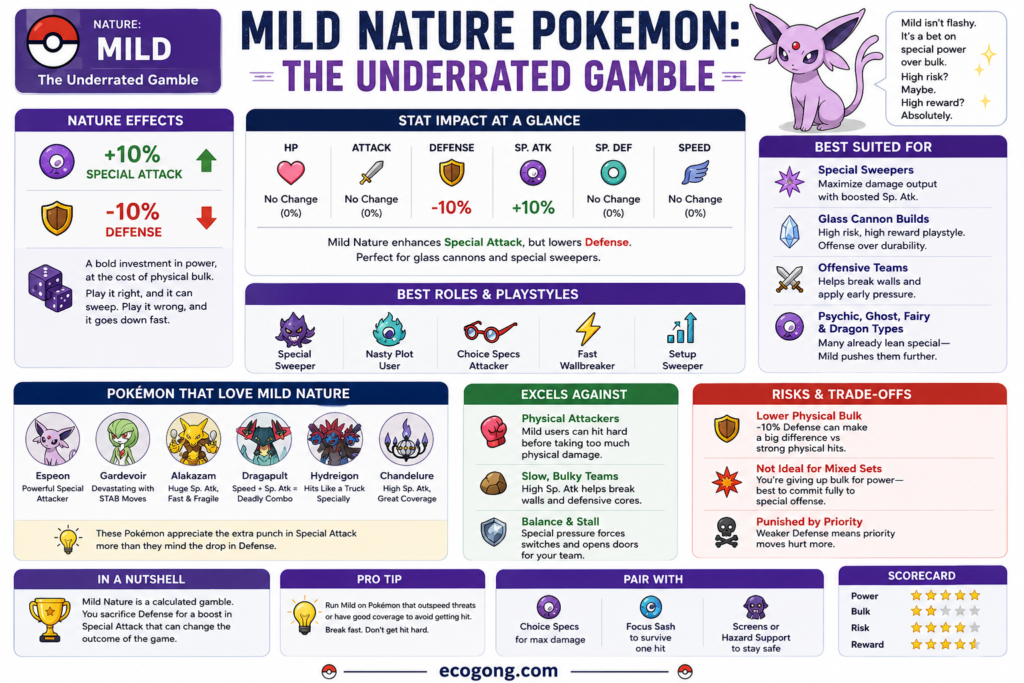
Mild raises Special Attack and lowers Defense.
Players skip this nature often and for a fair reason. Lowering Defense feels riskier than lowering a stat the Pokemon never uses. However, “riskier” doesn’t mean “bad.” Mild nature Pokemon can still work well in the right situation.
Mild tends to shine when:
- The Pokemon already runs fast and fragile, so Defense not saving it anyway
- You are playing casually, where survivability matters less than raw damage
- You want to build a glass-cannon on purpose
Alakazam fits this perfectly. It’s already thin on defense, so the Mild trade barely registers. Gengar works too, since it rarely stays in long enough to tank a physical hit.
In competitive play, Modest and Timid usually beat Mild because they skip the defensive sacrifice. But for casual teams or a deliberate glass-cannon strategy, Mild still earns its spot.
I tested a Mild nature Gengar for a few ranked matches out of curiosity, mostly to see if the extra Special Attack made up for the thinner Defense. It not take long to notice the trade off in practice: the small damage boost helped against bulky targets, but any unexpected physical hit dropped Gengar much faster than a Timid or Modest set would have. That hands-on test is exactly why I now recommend Mild only for players who already understand the risk they’re taking on.
A Simple Framework for Picking Any Nature
Now here check the exact process I use for every Pokemon I raise. This same framework works for picking pokemon natures no matter what generation you are playing.
Step 1: Define the Pokemon job. Pick one main role: attacker, tank, or support.
Step 2: Check its base stats. A Pokemon with high Attack and mediocre Special Attack rarely benefits from a Special Attack-boosting nature.
Step 3: Choose a nature that boosts the stat it depends on. Then look at what it lowers.
Step 4: Confirm the lowered stat is one the Pokemon barely uses. This step matters most, and it is the one people skip.
Use this cheat sheet as a shortcut:
| Role | Good Nature Options |
|---|---|
| Physical attacker | Adamant, Jolly |
| Special attacker | Modest, Timid |
| Physical wall | Bold, Impish |
| Special wall | Calm, Careful |
| Mixed attacker | Naive, Rash |
The Part Almost Nobody Talks About: Natures and Abilities
Now check this angle rarely shows up elsewhere, and it changes the whole strategy for certain Pokemon. Many articles explain pokemon natures on their own, without ever mentioning how abilities can change the equation.
Some abilities interact with stat changes in ways that flip nature strategy on its head.
Contrary reverses stat changes from moves. This works separately from nature, but players often confuse the two. Serperior, for sometimes runs unusual natures because its whole strategy depends on stat drops working in its favor.
Simple doubles the effect of stat changes from moves. Again, this not nature directly. Still, it changes how much a nature raw stat boost actually matters, since a Simple Pokemon stat swings already run dramatic.
Unaware ignores stat changes entirely during damage calculations. Because of this, a Pokemon with Unaware cares less about a nature lowered stat if that stat gets ignored in key matchups anyway.
The takeaway stays simple: do not choose a nature in a vacuum. Check the Pokemon ability first, since it can completely change what “optimal” means.
Natures Affect More Than Battle Stats
Check Here a detail almost every other articles skips.
Nature also shapes a Pokemon flavor preference. Every nature likes certain flavors, like sweet or spicy and dislikes others.
This detail shows up in a few places:
- Poffin and Pokeblock scores during Contests
- Berry preferences during activities like Pokemon Camp
- Certain affection based mechanics in newer games
If you chase high Contest stats or affection bonuses, nature quietly plays a role there too. It is a small detail but it proves nature reaches beyond just battle math.
Fixing a Bad Nature (Without Starting Over)
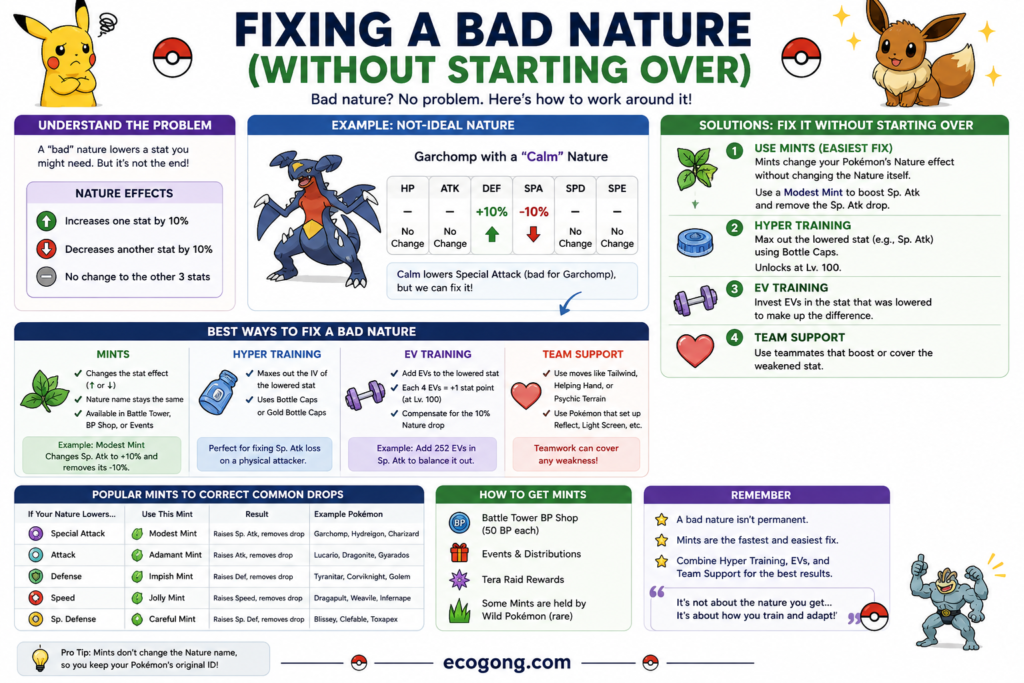
Caught a best Pokemon with a terrible nature? Do not release it. You can fix this.
Mints, introduced in Generation 8, apply a different nature’s stat effects without changing the Pokemon’s actual nature name. The boost and the drop change, but the nature label stays the same.
Here how it works in practice:
- Find or buy the Mint that matches the nature effect you want
- Use it on your Pokemon from your bag
- Watch its stat calculation update immediately
Many games offer Mints through in game shops, specific NPCs, or rewards. Because of this, Mints eliminate hours of breeding grind that used to be required.
Before Mints existed, players relied on the Synchronize ability instead. Holding a Pokemon with Synchronize and the nature you wanted improved your odds of finding a wild Pokemon with that same nature. It still works in games without Mints, just slower.
Pros and Cons of Obsessing Over Natures
Like any game mechanic, pokemon natures come with real trade offs worth weighing before you dive in.
Pros:
- Delivers a free stat boost with zero real cost
- Lets you tailor a Pokemon exactly to its role
- Mints make correcting a bad catch painless
- Swings close battles more often than players expect
Cons:
- Overwhelms brand new players at first
- Breeding for a “perfect” nature without Mints eats real time
- Tempts players to overthink casual, story mode play
- Weakens a Pokemon quietly, without any obvious warning sign
Mistakes I See Constantly (Including One of Mine)
I all admit my own slip up first. Early on, I bred an entire box of Timid Dragonite before realizing Dragonite Attack stat outclasses its Special Attack by a wide margin. A Speed boosting nature made sense, but I should have paired it with Attack, not Special Attack. That box of Dragonite sat unused for months until I bred a fresh batch with an Adamant nature instead. Lesson learned the hard way: check the actual base stats before you commit to a nature, not just the role you imagine for the Pokemon.
Here check some mistakes I see most often from other players too:
- Lowering a stat the Pokemon actually needs. This mistake happens most often, and a quick chart check avoids it every time.
- Confusing similar names. Modest and Mild both raise Special Attack, but they lower completely different stats. It is an easy mix up when skimming.
- Forgetting neutral natures exist. Hardy, Docile, Serious, Bashful, and Quirky do nothing at all. If a competitive Pokemon ends up with one, you are leaving free stats on the table.
- Ignoring ability interactions. As covered above, some abilities change how much a nature’s stat drop actually matters.
- Skipping Mints when they are available. Some players still breed for hours out of habit, not realizing Mints solve the same problem in minutes.
Frequently Asked Questions
What are pokemon natures? this are hidden traits that raise one stat by 10% and lower another by 10%. Twenty-five exist in total and five do nothing at all. Pokemon natures apply to every Pokemon in the game, whether you notice them or not.
What does Impish nature do? It raises Defense and lowers Special Attack, which makes it a strong pick for physical defensive Pokemon.
What does Mild nature do? It raises Special Attack and lowers Defense. Competitive players use it less often, but it suits glass-cannon or casual builds well.
How many pokemon natures are there? Twenty five natures exist. Twenty change stats and five stay neutral.
Can you change a Pokemon nature? Yes. Since Generation 8, Mints apply a different nature stat effects instantly, so you not need to catch or breed a new Pokemon.
Do natures affect anything besides battle stats? Yes. Natures also shape flavor preferences, which come into play during Contests and certain affection based mechanics.
Does nature matter for casual, non competitive play? A little. It not ruin a story playthrough, but a well matched nature makes tough battles noticeably easier.
What is the actual difference a nature makes in raw numbers? On a Pokemon like Garchomp, a beneficial nature adds roughly 30 plus points to a key stat at level 100. That is a measurable, real difference.
Final Words
Pokemon natures look small on paper: just a plus-10%, minus-10% swap. But once you run the real numbers, the impact turns out bigger than most players expect.
Whether you set up an Impish nature Pokemon as a defensive anchor, experiment with a Mild nature Pokemon as a fast attacker or fix an old catch with a Mint, the goal stays the same. Match the nature to what the Pokemon actually needs to do.
Start with the framework above. Check the chart whenever you are unsure, and not hesitate to correct a bad nature instead of starting over. That one habit alone will noticeably level up your team.