


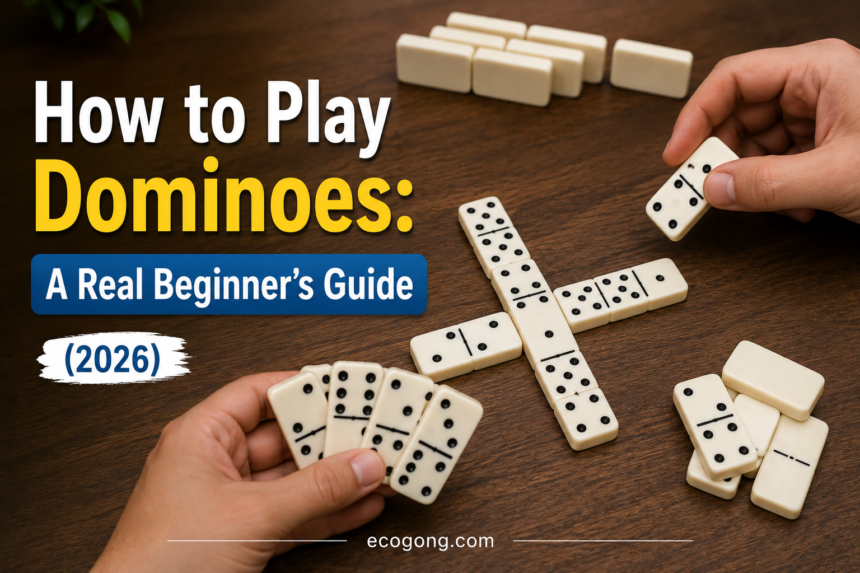
Dominoes is a tile matching game. Every player draws tiles, then takes turns placing a tile that matches a number already on the table. If you not match, you draw or pass. Whoever empties their hand first or has the lowest total if the game gets blocked wins.
Key Facts About Dominoes
- A best domino set is called “double six” and contains 28 tiles.
- Every tile has two halves, showing 0 to 6 dots per side.
- Many games deal 7 tiles per player when 2 or 4 people are playing.
- A round ends when one player empties their hand or when no one can move (called being “blocked”).
- Now UK scoring variant, Fives and Threes, is typically played to 61 points.
Introduction
Now, you are need to learn how to play dominoes is one of the easy tabletop skills you can pick up in a single sitting. The rules are short, and setup takes under a minute and you can play with as few as two people or as many as eight.
This article check for the real rules, not just the basics. You’ll find setup steps, player count breakdowns, the UK scoring variant, a kids teaching method and the house rules many other guides skip but you read here this big help for you all.
How to Play Dominoes: A Real Beginner’s Guide
What Is Dominoes?
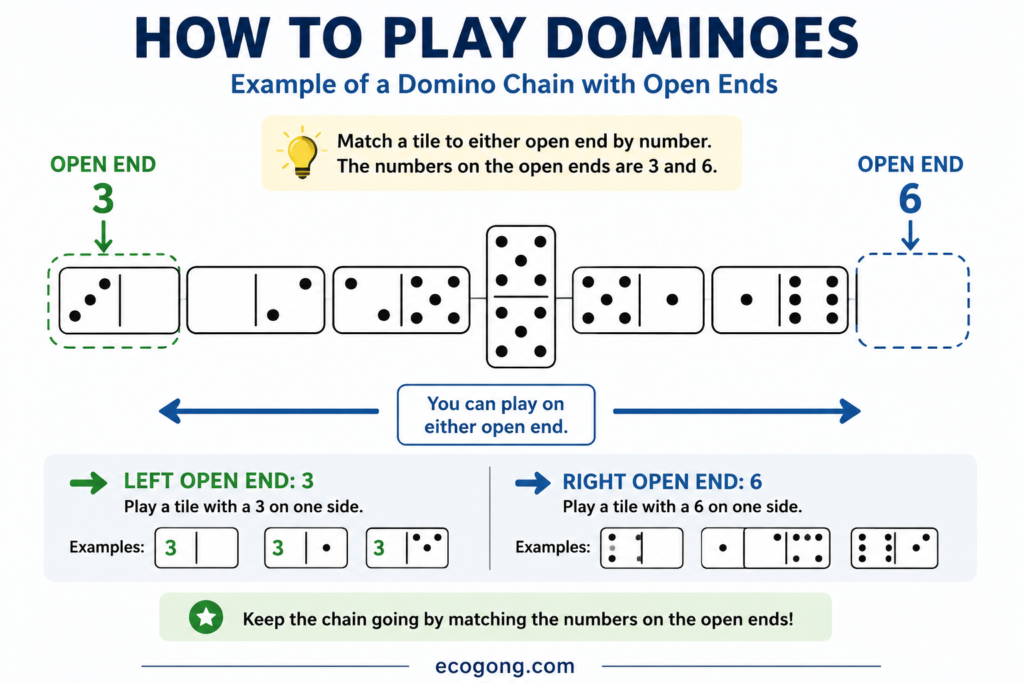
Dominoes are comes to tile based game where players match numbers to empty their hand first. every tile shows two numbers, from blank up to six on a standard set and players take turns connecting matching numbers on the table.
That is the mechanic, though. The real goal is getting rid of your tiles before anyone else does, while making sure nobody else can get rid of theirs easy.
Once you get that, the all game feels different. You stop playing whatever tile fits and start thinking about which one hurts your opponent many.
What’s in the Box
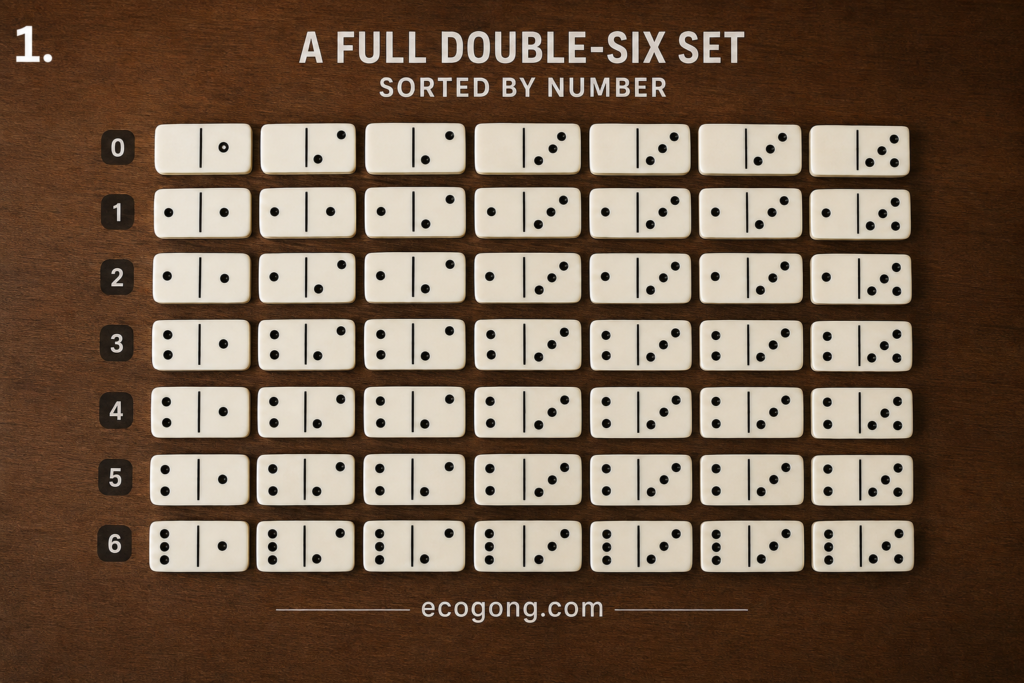
Here, Players call a standard set “double-six” because the highest tile shows a 6 on each side. It holds 28 tiles total and every number combination from 0-0 up to 6-6 shows up exactly once.
If you are playing with more than 4 people, grab a bigger set instead:
- Double-nine (55 tiles) — good for up to 6 players
- Double-twelve (91 tiles) — good for up to 8 players
For many homes and most games, though, double six covers everything you’ll ever need.
Setting Up a Game
- Flip every tile face down and mix them around on the table. Players call this “shuffling the boneyard.”
- Every player draws their tiles without looking. The exact number depends on player count more on that below.
- Leave the rest face down in the middle. That is your draw pile for the rest of the game.
- Whoever holds the highest double goes first. If nobody has a double, the highest total tile starts instead.
How to Play Dominoes: The Rules, Step by Step
This works no matter how many people you are play at the table.
Step 1: Place the first tile in the middle. That leaves two open ends on the board, one on each side.
Step 2: Take turns clockwise. Every turn, play a tile that matches a number showing on either open end.
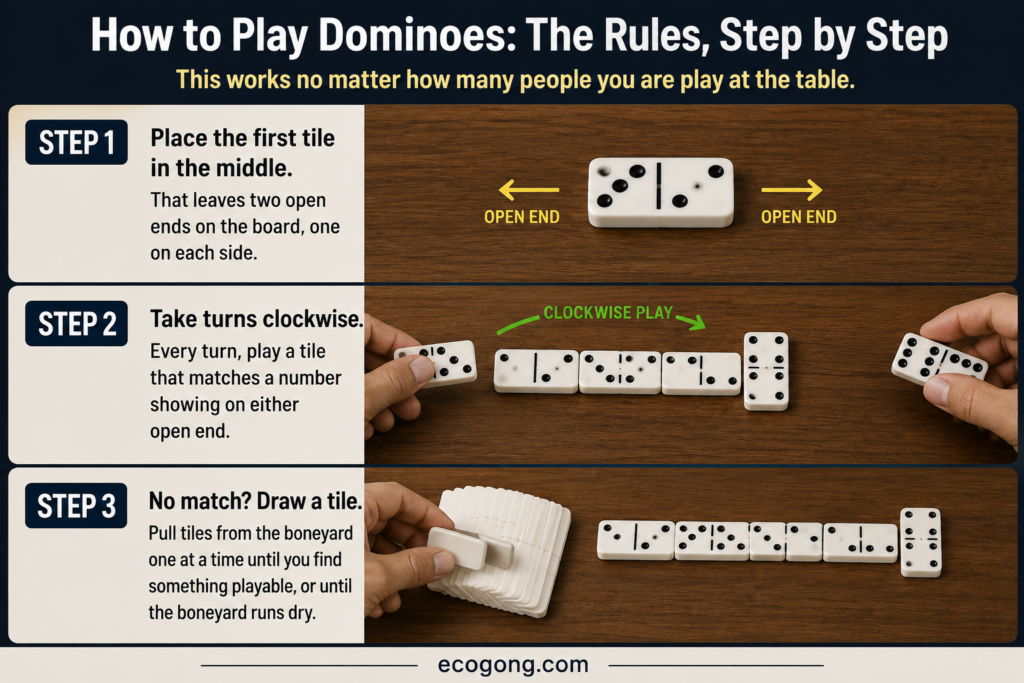
Step 3: No match? Draw a tile. Pull tiles from the boneyard one at a time until you find something playable, or until the boneyard runs dry.
Step 4: Still nothing? Pass. Just say “pass” and play moves to the next person. There is no penalty, you simply lose that turn.
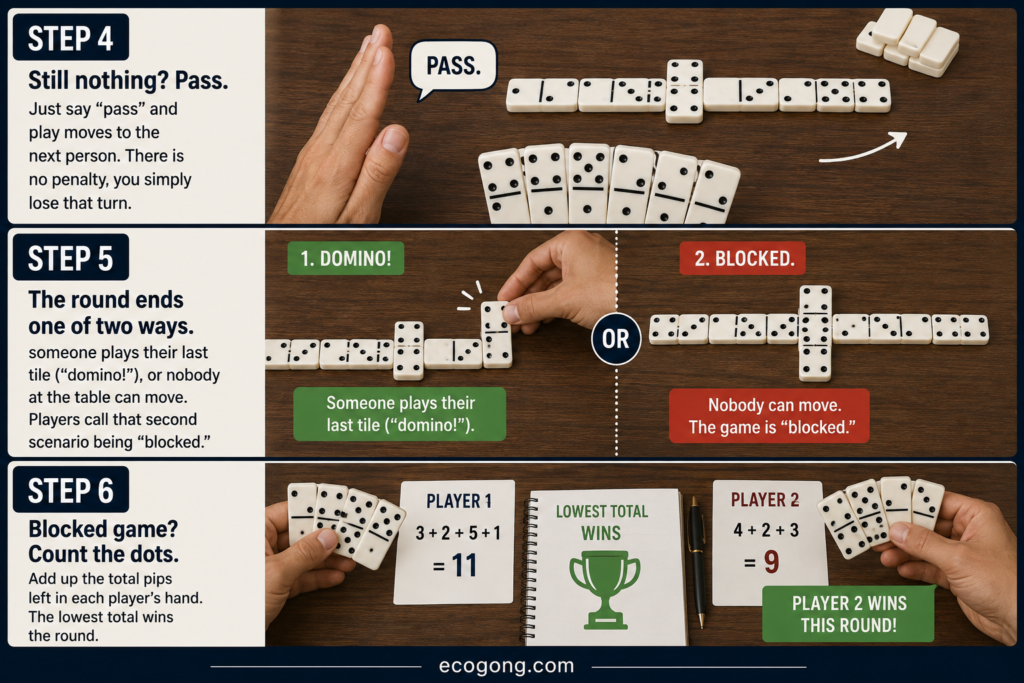
Step 5: The round ends one of two ways. someone plays their last tile (“domino!”), or nobody at the table can move. Players call that second scenario being “blocked.”
Step 6: Blocked game? Count the dots. Add up the total pips left in each player’s hand. The lowest total wins the round.
Playing with 2 People
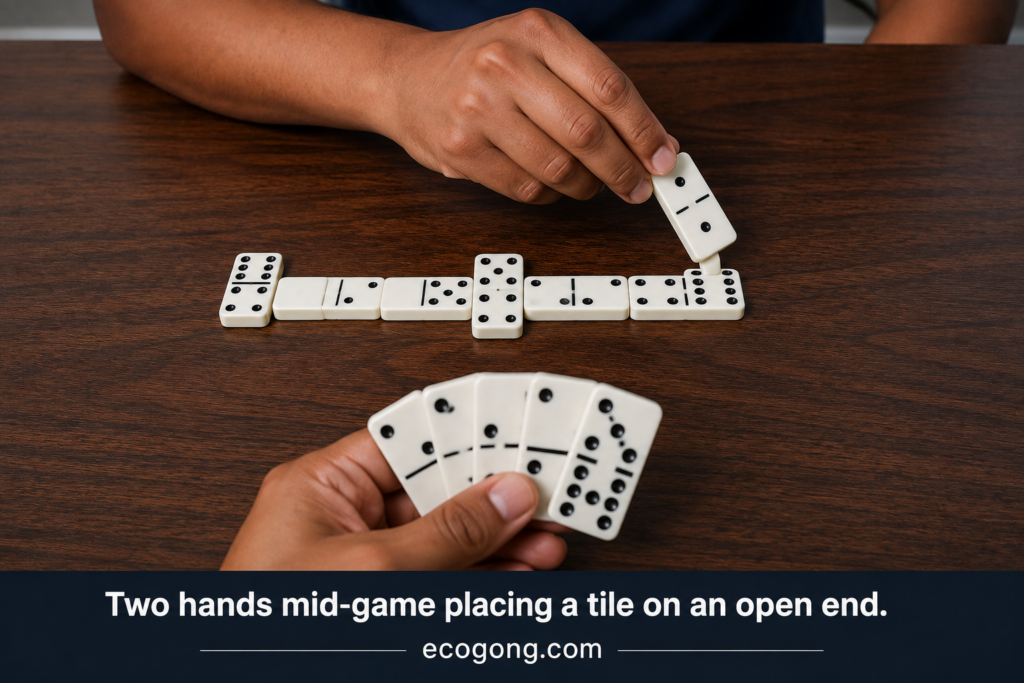
Now, Two player games are the quick way to learn dominoes. That is why I always recommend starting here if you are never played before.
Setup: Each player draws 7 tiles. Everything else stays in the boneyard.
What’s different: When you face just one other player, it’s far easier to figure out what they’ve got. Say they keep picking tiles instead of playing on a certain number chances are, they not have that number in their hand. Store that data safely. You can use it to interfere with their plans down the line.
As soon as you understand it, a full game typically finishes in about 5 to 10 minutes.
Playing with 3 People
Setup: Each player draws 7 tiles from a double six set. Some groups use 5 tiles instead agree on this before you start, since it changes the pace a lot.
Three-player games play differently. You’re dealing with two challengers instead of one, and that extra player makes the whole board way more unpredictable.
Honestly, this setup’s the craziest and I mean that in a good way. It’s perfect for a relaxed game evening. Nobody’s really in control, and that makes things a lot more exciting.
Playing with 4 People (Teams)
You all see this setup most in pubs, family kitchens and Caribbean domino nights also it’s the classic version.
Setup: Each player draws 7 tiles. Partners usually sit across from each other, not next to each other.
How teams work:
- You not show your partner your tiles or tell them what you are holding.
- You can, however, signal through play. If your partner keeps laying tiles with a 3 on them, they are probably holding more 3s or trying to clear that number.
- The round ends the moment any player on either team empties their hand. That player’s team wins the round, even if their partner is still holding a full hand.
Dominoes stops feeling like a solo puzzle here and starts feeling like an actual team sport. Reading your partner is plays is half the skill.
UK-Style Dominoes: Fives and Threes
how to play dominoes in UK Style so check below good tips.
The scoring works like this:
- After every tile placement, add up the numbers showing on both open ends of the board.
- If that total divides evenly by 5, score 1 point for every 5 in it.
- If it divides evenly by 3, score 1 point for every 3 in it.
- Some totals score both ways a total of 15 earns 3 points for the 5s and 5 points for the 3s, for 8 points total.
Many games run to 61 points. Serious players track the score on a small peg board, the same style you’d see in cribbage.
What I like about this version is it forces you to plan several moves ahead. you are not just racing to empty your hand, you’re setting up scoring numbers while blocking your opponent’s chances too.
Teaching Dominoes to Kids
A many articles just say “it’s great for kids” and leave it at that. Here you check a method that actually works, from teaching it to my own family:
Start face-up not face-down. Let kids see everyone’s tiles for the first few rounds. Guessing what to play is a separate skill from understanding the matching rule, so teach one at a time.
Count out loud together. Have them say the number of dots as they place each tile. It builds number recognition quietly, without ever feeling like a math lesson.
Use a small hand size. Five tiles instead of seven keeps rounds short enough that a 6- or 7-year old stays engaged to the end.
Skip scoring at first. Focus only on “match the number, get rid of your tiles.” Add scoring once matching feels automatic.
Let them win sometimes, but explain why. If they win because you made a bad move on purpose, tell them afterward. It keeps the game honest and still teaches strategy.
In my experience teaching younger cousins and nieces, the face up first approach makes the biggest difference. Kids get frustrated fast when they not see what’s “allowed,” and face up play removes that frustration completely.
Dominoes in Red Dead Redemption 2
If you read here looking for the video game version, this is the one you want.
RDR2 includes a fully playable dominoes mini game against NPCs. you all usually find it at saloon tables in towns like Rhodes, Blackwater and Saint Denis.
How to play it:
- Walk up to a table with dominoes on it and interact to sit down.
- Select your wager the game lets you bet in game cash before starting.
- Play out standard block dominoes rules: match numbers, empty your hand first, or win on lowest total if blocked.
- NPC difficulty varies by opponent, so try a different saloon or NPC if you lose early.
It’s a best way to practice real dominoes logic in a low pressure setting, even if you are never touched a physical set before.
Popular Variations Worth Knowing
Standard block dominoes not the only game in town. A some others come up often enough to know by name:
- Draw Dominoes — Same as block, but you must draw at least one tile before you’re allowed to pass.
- All Fives — You score points anytime the open ends total a multiple of 5, similar to Fives and Threes but with simpler math.
- Mexican Train — Played with a double twelve set. Every player builds their own branching “train” of tiles, plus there is a shared public train in the middle.
- Chicken Foot — A Mexican Train spinoff. Playing a double forces you to add three more tiles branching off it and the resulting shape looks like a chicken’s foot.
If you are mastered basic block dominoes, try Mexican Train next. It is many social and takes longer, which makes it a best fit for bigger groups.
What to Do When Something Goes Wrong (House Rules)
Almost no-one writes about this, yet it comes up constantly once you are actually playing.
Someone played out of turn. many house rules let you simply undo the move if you catch it immediately. Once a full turn passes, though, the move usually stands.
Someone miscounted their dots at the end. Recount together before finalizing the score. Genuine mistakes happen, especially with double nine or double-twelve sets.
A player realizes they missed a valid move earlier. best etiquette says the game keeps moving forward. You not get to replay a turn once the next person has already played.
Someone accidentally reveals a tile. Casual play carries no official penalty here, but most groups agree that tile becomes “known” information for the rest of the round.
Nobody agrees on how many tiles to draw for 3 players. Decide this before the game starts, not mid round. Write it down if you play with the same group regularly, so it stays consistent every time.
Setting these expectations out loud before you start saves arguments later. I always ask new groups one question before dealing: “5 tiles or 7 for three-player games?” It takes ten seconds and heads off a debate halfway through the round.
Mistakes New Players Make Constantly
- Checking only one end of the table. all ends are playable. New players forget the second one more often than you’d think.
- Playing doubles too early. Doubles matter because they open a new direction on the board. Save them for when you actually need the flexibility.
- Ignoring passes. When an opponent passes, also that tells you something helpful. Skip that clue and you are throwing away free information.
- Rushing the draw. In draw dominoes, players sometimes stop the moment they find any playable tile, even a bad one. It’s often worth drawing one more if the boneyard still runs deep.
- Skipping the hand size agreement for 3+ players. Nothing else on this list causes more mid game arguments.
Tips That Actually Improve Your Game
- Hold your doubles until you need a way out, not until you are forced to play them. A double played at the right moment can completely block an opponent.
- Count the boneyard. Knowing how many tiles remain tells you how likely opponents are to hold a match versus getting forced to pass.
- Do not cluster your hand around one number. If you are holding four tiles with a 3 on them, you’re stuck the moment 3s dry up on the board.
- In team games, play defense for your partner, not just offense for yourself. Maytime’s your best move not your best tile, it’s the one that keeps the board open for your partner.
- In scoring variants, calculate ahead before you place a tile. Fives and Threes rewards players who work out the next total before committing, not after.
Comparison Table to How to Play Dominoes
| Format | Players | Tiles Each | Skill Emphasis |
|---|---|---|---|
| Basic Block | 2 | 7 | Reading one opponent closely |
| Basic Block | 3 | 5-7 (agree first) | Managing unpredictability |
| Team Block | 4 | 7 | Partner communication through play |
| Fives and Threes | 2-4 | 7 | Scoring math, forward planning |
| Mexican Train | 4-8 | Varies by set size | Long-game strategy, branching options |
FAQs
how to play dominoes for beginners? Draw 7 tiles each, then take turns matching a number on your tile to an open end on the table. and Draw from the leftover pile if you can’t match and pass once the pile runs out. First to empty their hand wins.
How many dominoes do you draw for 2 players? Each player draws 7 tiles from a standard double six set, leaving 14 tiles in the boneyard.
What happens if nobody can play in dominoes? The game is “blocked.” Every player adds up the dots left in their hand and whoever holds the lowest total wins that round.
Is dominoes hard to learn? Not really. The core rule match the number, empty your hand takes about two minutes to explain. Method takes longer to build, but you can play a full game the first time you sit down.
What’s the difference between dominoes and Fives and Threes? Basic dominoes only cares about who empties their hand first. Fives and Threes also awards points during play, whenever the open ends of the board add up to a multiple of 5 or 3.
Can kids really play dominoes? Yes, and it helps with early math skills. Start with tiles face up and a smaller hand size, also then move to standard rules once matching feels comfortable.
How do you play dominoes in Red Dead Redemption 2? Sit at any dominoes table in a saloon, select a wager and play out standard block style rules against an NPC match numbers, empty your hand first, or win on the lowest total if the game gets blocked.
Final Words
Learning how to play dominoes takes about five minutes. Getting good at it takes a few real games against people who actually try to beat you.
Now, you Start with a basic two player round to nail the mechanics. Once matching feels automatic, move up to 3 or 4 players, and try the UK’s Fives and Threes for a scoring challenge, or branch into Mexican Train for something longer and more social.
The rules rarely change much. What separates a casual player from someone who wins consistently is the thinking behind each tile they place. Grab a set, sit down with a few people and you all pick up the difference fast.